Table of Contents
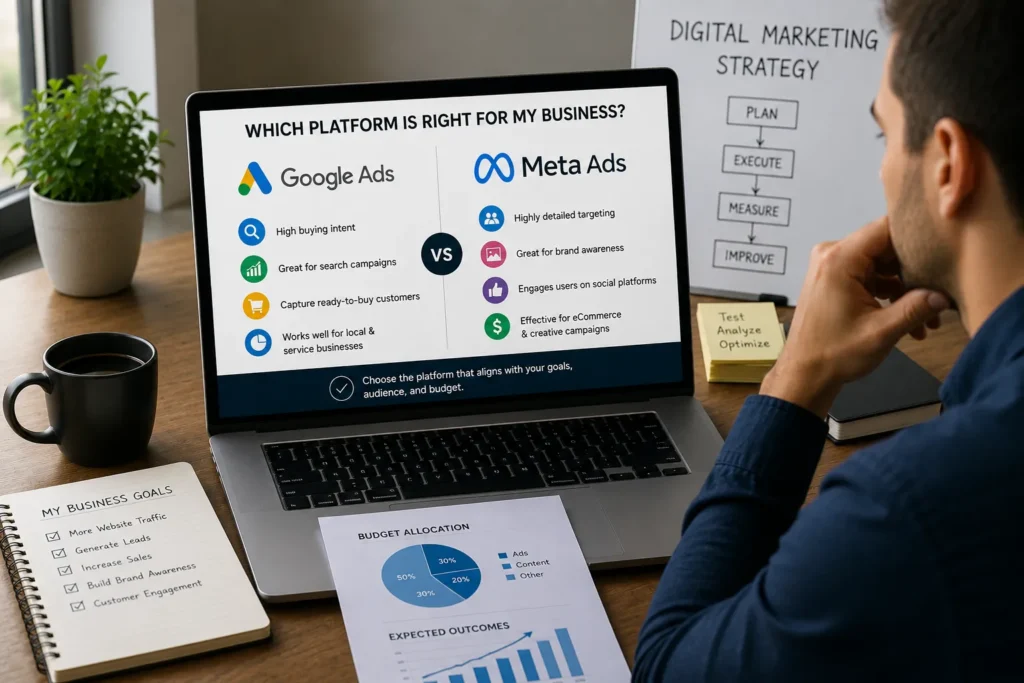
Google Ads vs Meta Ads is one of the most important comparisons for businesses planning a paid advertising strategy. Both platforms can support awareness, traffic, leads, and sales, but they reach people differently. Google often connects a business with users who are actively searching, while Meta can introduce an offer based on audience signals and content-consumption behavior.
The right choice depends on existing demand, customer intent, the sales cycle, creative resources, tracking quality, budget, and the action you want users to take. Different business models may need very different approaches.
This guide examines Google Ads vs Meta Ads from a practical business perspective. It explains how each platform reaches audiences, how campaign objectives differ, and what creative and landing-page requirements should influence the decision. The goal is to evaluate Google Ads or Meta Ads for small business without assuming one is universally better.
Google Ads vs Meta Ads: The Core Difference Is User Intent
User intent describes what a person is trying to accomplish at a particular moment. Understanding that moment is central to the Google Ads vs Meta Ads decision because the same person may behave differently while searching for a service and while browsing social content.
How Google Ads Captures Existing Demand
Google Search campaigns are designed to reach people searching for relevant products or services. Keywords and search terms help determine when an ad may be eligible to appear. This makes Search useful when customers already know what they need and are using specific phrases to find a provider, product, price, or solution.
For example, someone searching for “emergency plumber near me” is expressing an immediate need. A company offering that service may benefit from appearing at that moment, provided the keyword targeting, location settings, ad message, landing page, and conversion tracking are properly configured.
Not every Google Ads click has high purchase intent. Broad searches may attract researchers rather than buyers. Effective campaigns need relevant keywords, negative keywords, organized ad groups, and landing pages that match the search. Businesses considering professional Google Ads management should confirm how search terms and conversions will be reviewed.
Google’s official guide to creating a Search campaign explains how Search campaigns can support sales, leads, or website traffic by reaching people searching for specific products and services.
How Meta Ads Creates and Influences Demand
Meta Ads commonly reaches people while they are consuming social content rather than actively searching for a product at that exact moment. Advertisers can build audiences using factors such as location, demographics, interests, behaviors, existing customer data, and platform optimization systems.
This environment supports discovery. A user may not search for an offer today, but a relevant ad can create awareness. Effective Meta Ads management therefore depends on clear positioning, suitable creative, audience strategy, and continuous testing.
Meta organizes campaign choices around objectives such as awareness, traffic, engagement, leads, app promotion, and sales. Selecting the right objective matters because it tells the delivery system what type of result the campaign should pursue. Meta’s official explanation of choosing an advertising objective provides additional guidance for campaign setup.
When comparing Google Ads vs Meta Ads, it can be helpful to think of Google Search as demand capture and Meta Ads as demand discovery or demand generation. This is a useful planning framework rather than an absolute rule. Both platforms can contribute to several stages of the customer journey.
How Intent Changes the Best Platform Choice
Consider how customers normally begin their buying process. Do they search as soon as a problem appears? Do they need education before recognizing the value of an offer? Is the product visually appealing? Does the decision require repeated exposure, comparison, or consultation?
Choosing Google Ads or Meta Ads for small business becomes easier after answering these questions. Search-led services may begin with Google, while visually driven or unfamiliar offers may benefit more from Meta. Some businesses use both platforms: Meta builds familiarity, while Google captures later branded or solution-focused searches.

Google Ads vs Meta Ads Audience Targeting and Customer Reach
Targeting is sometimes discussed as though one platform is precise and the other is broad. In reality, Google Ads vs Meta Ads offers different targeting methods because users provide different signals to each advertising system.
Google Ads Targeting Starts with Queries and Context
Google Search targeting begins with words and phrases related to customer searches. Match types influence how closely a keyword must relate to a search query before an advertisement may enter the auction. Location, language, device, schedule, audience signals, and other settings can further shape campaign delivery.
Strong targeting begins with understanding customer language. A company may describe a service differently from the phrases potential customers actually use. Reviewing search terms after launch can reveal irrelevant traffic, identify negative keyword opportunities, and uncover valuable search patterns.
A Google Ads campaign should therefore be evaluated using more than impressions and clicks. Search queries, qualified leads, conversion quality, geographic accuracy, and landing-page behavior also matter. High traffic offers little business value when it comes from the wrong audience or search intent.
Meta Ads Targeting Starts with People and Predicted Response
Meta allows advertisers to reach audiences using demographic information, interests, behaviors, customer-based audiences, and automated audience tools. The platform can combine advertiser inputs with its delivery systems to identify people who may be more likely to complete the selected campaign action.
This approach can reach potential customers before they express demand through a search engine. It may be useful for visually demonstrable offers, identifiable customer groups, new products, or campaigns supported by suitable first-party audience data.
However, audience selection cannot rescue an unclear offer. Performance also depends on creative quality, conversion tracking, available data, landing-page quality, and whether the selected conversion represents a meaningful business outcome. Advertisers should never assume that targeting will be perfect.

Google Ads vs Meta Ads Campaign Objectives and Ad Formats
In the Google Ads vs Meta Ads comparison, the advertising message is delivered differently on each platform. The decision must account for both the audience environment and the type of creative content a business can produce consistently.
Google Ads Formats Often Begin with Relevance
Search ads rely on concise written assets, keyword relevance, supporting ad assets, and a landing page that answers the user’s query. Specific service details, location information, clear benefits, and an appropriate call to action are usually more useful than broad or unsupported promotional claims.
Other Google campaign types may use images, videos, product information, or combinations of different assets. The campaign type and format should follow the business objective instead of being selected only because it offers broader reach.
Meta Ads Formats Depend More Heavily on Creative
Meta supports formats such as single-image, video, and carousel advertisements, although availability may depend on the campaign objective and placement. Its official overview of advertising formats in Meta Ads Manager explains the primary creative options.
The creative must capture attention within a social content environment. Strong openings, readable visuals, relevant copy, and message continuity are essential. A carousel may present several products or benefits, while a video can demonstrate a problem, introduce a solution, and communicate value.
Businesses comparing Google Ads or Meta Ads for small business should consider whether they can produce and test appropriate creative assets. A platform may be strategically relevant but operationally unsuitable when the business lacks the content, time, budget, or process required to support it.
The Landing Page Must Continue the Same Message
Neither advertising platform can fully compensate for a weak destination. A user clicking an advertisement for a specific service should not arrive on a generic homepage and search for the relevant information. The landing page should continue the same offer, audience promise, and call to action.
Before increasing advertising spend, confirm that the website is mobile-friendly, clear about the offer, and capable of recording meaningful conversions. Businesses with an unsuitable destination may need to review their website design service options before scaling advertising campaigns.
The final Google Ads vs Meta Ads choice should therefore be treated as a business-system decision rather than a simple choice between two advertising dashboards. Customer intent, audience signals, objectives, creative capacity, website quality, and measurement must work together.
Which is better for small businesses: Google Ads or Meta Ads?
There is no universal winner in the Google Ads vs Meta Ads comparison. Google Ads may be more suitable when potential customers are actively searching for a specific product or service. Meta Ads may be more effective when a business needs to build awareness, introduce a new offer, or reach people based on audience characteristics and likely interests. The right choice depends on customer intent, campaign goals, creative resources, and measurement quality.
Is Google Ads better for generating leads?
Google Ads can be effective for lead generation when people already search for the service being offered. Search campaigns use keywords and match types to connect advertisements with relevant searches. However, results also depend on competition, bidding, location settings, ad relevance, landing-page quality, and conversion tracking. Google Ads should not automatically be considered better simply because it captures search demand.
Is Meta Ads better for brand awareness?
Meta Ads can be suitable for brand awareness because advertisements appear while users consume content across Meta technologies. Businesses can use visual formats to introduce products, explain benefits, and create familiarity before a person actively searches. Meta includes awareness as one of its main campaign objectives, alongside traffic, engagement, leads, app promotion, and sales.
Which platform is more affordable for a new business?
The more affordable platform is the one that produces meaningful business outcomes at a sustainable cost. A lower cost per click does not necessarily mean better performance if the traffic does not convert. Compare qualified lead cost, customer acquisition cost, conversion rate, average order value, and lead quality. Advertising costs vary according to audience, industry, location, competition, campaign setup, and creative quality.
Should I choose Google Ads or Meta Ads for small business marketing?
Choosing Google Ads or Meta Ads for small business marketing begins with understanding how customers discover the offer. Google Ads may be a practical starting point for urgent, local, or search-driven services. Meta Ads may be more appropriate for visual products, unfamiliar solutions, or offers that require education. A business with sufficient budget and tracking may use both platforms at different stages of the customer journey.
Can Google Ads and Meta Ads be used together?
Yes. The platforms can perform complementary roles. Meta Ads may introduce the business and build awareness, while Google Ads may capture people who later search for the brand, service, or solution. Businesses can also use retargeting strategies where appropriate. Successful coordination requires consistent messaging, reliable tracking, suitable landing pages, and separate performance evaluation for each platform.
Which platform offers better audience targeting?
The answer depends on the targeting signal needed. Google Search primarily responds to search queries, keywords, context, and campaign settings. Meta provides audience options based on advertiser inputs, customer audiences, demographics, interests, behaviors, and automated delivery systems. Meta also allows advertisers to define audiences or use automated audience targeting. Neither platform can guarantee perfect targeting or high-quality conversions.
How long does it take to see results from Google Ads vs Meta Ads?
Both platforms can begin generating impressions and clicks after campaign approval, but meaningful evaluation requires enough conversion data. The required period varies according to budget, traffic volume, sales cycle, objective, and conversion frequency. Avoid making major decisions after only a few clicks or one short test. Review lead quality, conversions, search terms, creative performance, and overall profitability before scaling or stopping a campaign.
Google Ads vs Meta Ads: A Practical Comparison for Business Goals
The most useful way to compare Google Ads vs Meta Ads is to begin with the business outcome. A company may need immediate leads, awareness, product discovery, sales, or bookings. Each objective changes the audience signal, creative format, landing page, and measurement plan required.
Google Search is often strongest when people already recognize a need and actively look for a solution. Meta Ads can be valuable when a business needs to introduce an offer, demonstrate its value visually, or reach relevant audiences before they search. The best answer may also involve using both platforms in a coordinated customer journey.
Choose Google Ads for Active Search Demand
Google Ads may be the stronger starting point when customers use clear, commercially relevant searches. Local services, urgent problems, professional services, and considered purchases can benefit when a campaign appears while a user is actively comparing options.
However, search demand must exist. A new or unfamiliar product may receive few relevant searches even when the offer is valuable. The Google Ads vs Meta Ads decision should therefore consider whether the market already understands the problem and the language used to describe the solution.
Choose Meta Ads for Discovery and Visual Communication
Meta Ads may be more suitable when the offer is visually engaging, requires demonstration, or benefits from repeated exposure. Businesses must produce useful creative variations and communicate value quickly. When comparing Google Ads or Meta Ads for small business, creative capacity is a real operational requirement.
Use Both Platforms When the Journey Requires It
A combined strategy may use Meta to build awareness and Google to capture later searches for the brand, service, or problem. In many cases, Google Ads vs Meta Ads is a question of sequencing rather than choosing only one channel.
Reviewing Google Ads project examples and Meta Ads project examples can help clarify how objectives, audiences, creative assets, and conversion paths differ.

Best Practices for Google Ads vs Meta Ads Campaigns
Effective paid advertising requires more than launching ads. These practices make the Google Ads vs Meta Ads comparison more reliable by measuring both platforms against meaningful business outcomes.
Define a Valuable Conversion Before Launch
A conversion should represent an action that matters, such as a qualified inquiry, consultation, purchase, or phone call. Page views and clicks are useful diagnostic metrics, but they are not final results. Separate high-value actions from weaker engagement signals.
Build Platform-Specific Campaigns and Landing Pages
Do not copy the same message into every platform. Search users may respond to relevance, service details, and immediate answers. Social audiences may need a stronger introduction, visual explanation, or evidence that helps them understand why the offer matters.
The landing page should continue the promise made in the advertisement. A campaign promoting one service should lead to a focused page about that service, not a generic homepage. This alignment makes the Google Ads vs Meta Ads evaluation more useful.
Allow Enough Data for Responsible Decisions
Avoid declaring a winner after a few clicks or one conversion. The required testing period depends on budget, traffic, conversion frequency, and sales cycle. Document the audience, offer, creative approach, conversion, budget, and decision rule before testing Google Ads or Meta Ads for small business.

Common Google Ads vs Meta Ads Mistakes to Avoid
Comparing Cost Per Click Without Lead Quality
A cheaper click is not automatically a better result. Compare qualified lead cost, customer acquisition cost, revenue, and conversion quality whenever those data are available. Platform traffic should be judged by business value, not by click price alone.
Selecting the Wrong Objective or Conversion
Campaign systems optimize toward the objective and signals they receive. Choosing traffic when the real goal is qualified leads can produce visits without meaningful inquiries. Counting weak actions as primary conversions may also encourage volume rather than value.
Fragmenting a Limited Budget
New advertisers often create too many campaigns, audiences, ad groups, or creatives. A small budget divided across numerous tests may not produce enough useful data. A focused Google Ads vs Meta Ads plan should prioritize the most important audience, offer, and conversion before expanding.
Changing Campaigns Too Frequently
Frequent edits make performance difficult to interpret. Meta explains that ad sets enter a learning phase while its delivery system explores audiences and placements. Its official performance marketing guidance discusses learning and campaign simplification.
Sending Paid Traffic to a Weak Website
Slow pages, unclear offers, broken forms, poor mobile layouts, and missing trust information can waste advertising spend. Paid media cannot repair a website that makes the next step difficult.

How Much Do Google Ads and Meta Ads Cost?
There is no universal price for every Google Ads vs Meta Ads campaign. Costs vary by competition, location, audience, objective, bidding, creative quality, seasonality, and demand. Management, creative production, landing pages, and tracking can also create expenses beyond media spend.
How Google Ads Costs Are Determined
Google Ads uses auctions to determine whether advertisements are eligible to appear and how they are ranked. Google states that Ad Rank considers factors including competition, search context, and ad quality. A higher bid alone does not guarantee the best outcome. The official guide to Google Ads Ad Rank explains these factors.
Advertisers can set an average daily campaign budget. Actual daily spending may vary as the system responds to available opportunities, subject to applicable limits. Review Google’s official average daily budget guidance before estimating monthly spend.
How Meta Ads Costs Are Determined
Meta also uses an advertising auction and evaluates factors related to the objective, audience, budget, duration, and creative. Its official Meta ad auction overview explains the main components involved.
Meta does not provide one universal cost for every advertiser. Its advertising budget and pricing guidance explains that multiple factors influence campaign cost. Test budgets should be based on the business’s economics rather than an unrelated average.
Build a Budget Around Business Economics
Begin with the maximum sustainable cost for acquiring a customer or qualified lead. Consider transaction value, profit margin, close rate, repeat purchases, and the time required to recover advertising spend. These figures are more useful than asking which platform offers the cheapest clicks.
In a Google Ads vs Meta Ads test, allocate funds according to each platform’s role. Equal budgets are not necessary when available demand, creative requirements, and expected outcomes differ.
Google Ads vs Meta Ads: Which Platform Should You Choose?
Choose Google Ads first when customers actively search for the offer, the business can identify commercially relevant keywords, and the landing page can answer those searches clearly. Choose Meta Ads first when discovery, visual communication, audience education, or repeated exposure is central to the buying process.
For some businesses, the best Google Ads vs Meta Ads strategy combines both platforms. Meta can introduce the offer and build familiarity, while Google captures later demand. Each platform should have a distinct role, conversion goal, and reporting structure.
Before investing, confirm the goal, customer journey, tracking, creative capacity, website quality, and budget. The right platform connects a suitable audience with a strong offer and a measurable next step.
Businesses comparing Google Ads or Meta Ads for small business can review the available digital marketing services and use the contact page to discuss campaign goals. A focused consultation can help determine whether search advertising, social advertising, or a coordinated strategy fits the business.